
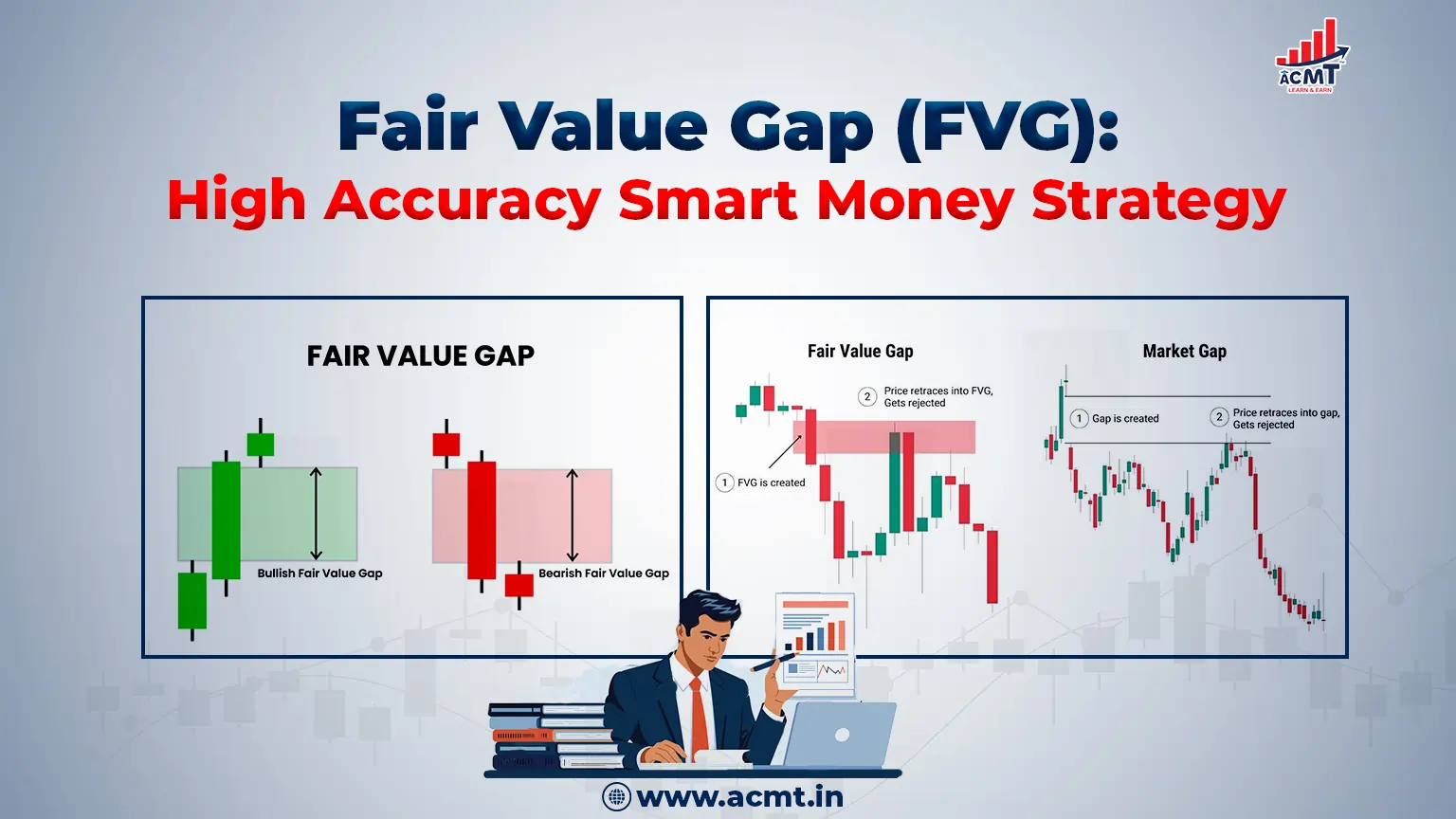
Fair Value Gap (FVG): High Accuracy Smart Money Strategy
Overview – FVG
FVGs are not automatic buying or selling zones. Incidentally, most traders use it as such. This is because of the terms “bearish FVGs” and “bullish FVGs,” which are common. Consequently, every price gap indicator is visualized as a high-probability opportunity. However, this may not be true, and not every FVG is healthy. Sharp price movements are often driven by aggressive buying and selling, which can create gaps. But this does not make them active or valid FVG trade zones.
- Fair value gaps (FVGs) are where the candlestick squares do not fully overlap, displaying high probability trading zones.
- Inverse Fair Value Gaps (IFVGs) go beyond the trend line break to become the opposite as the characteristics of the FVGs change and turn levels of support into resistance. : These are price inefficiencies where the squares of the candlestick graph do not entirely overlap, thus producing zones with a high probability for trading.
- ACMT offers tools, scanners and indicators that help identify such trading patterns.
What is a Fair Value Gap in trading?
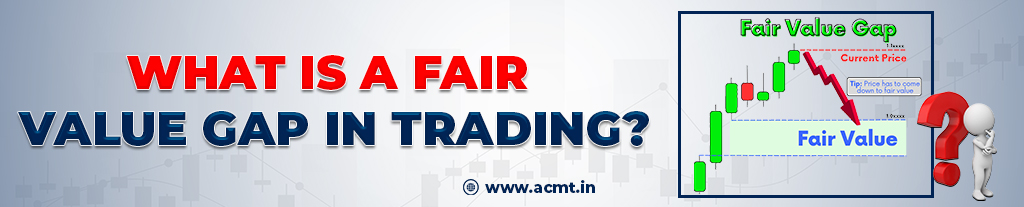
When the price moves quickly through a three-candlestick pattern and leaves a void, or gap, between candles one and three, it is called a fair-value gap. The market apparently skips a section, creating a pricing imbalance. It’s a space where normal trading was not carried out. Typically, the market moves sideways, creating an equilibrium or consolidation, right before the gap. Resonating with the stability of market sentiment, the sideways range is coined ‘fair value’. With reports of earnings and positive economic views, the market sees a sharp move and skips price levels.
However, FVGs can appear at any time and in any market condition. Even a classic chart formation, such as the sloping flag pattern, can develop FVGs across various environments. Still, not every gap is a fair value gap.
Regular gaps appear after overnight moves and earnings, but are not the same as the three-candlestick pattern in the FVG. With large institutional trades, major plays by market participants or hedge funds, there’s an imbalance in supply and demand, triggering true FVG. This shows that smart money is created by strong buying or selling pressure, not by random volatility.
FVG Explained for Beginners
Most novices can get confused by the terms “imbalance” and “efficiency” in FVGs. These are not different terms, though. Indeed, they are cause and effect. When you see a sharp movement and an imbalance between supply and demand, you will also notice that one side is under aggressive pressure, and it just so happens they did not have time to respond. This imbalance is the cause, and the effect is the inefficiency displayed on the chart, otherwise called the fair value gap.
Thus, when either buyers or sellers become aggressive and overwhelm each other, a fair value gap appears.
Fair Value Gap Trading Strategy
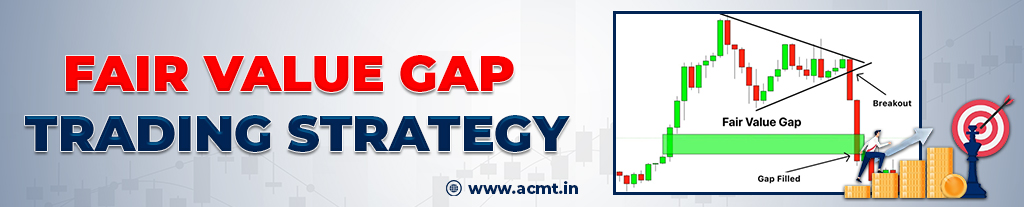
While FVG price action identifies broken balances on a chart due to frequent price pullbacks, other gaps, such as the inverse fair value gap (IFVG), serve as turning points. ACMT offers simple explanations with the Fair Value Gap Trading course, familiarizing learners with scanners, tools and indicators to detect FVGs and IFVGs in a particular market.
How to identify a fair value gap?
- Look for candlestick overlaps to identify the FVG or IFVG
- Wait until price Fills or Retests: Wait for a price pullback, then follow the trend for FVG; for IFVG, look for a retest of the new demand/supply zone.
- Check the gap’s bias and then enter the trade: short for bearish gaps and long for bullish if it’s an FVG, and for IFVGs when the gap changes to bullish from bearish, it’s long, and when the gap changes to bearish from bullish, it’s short.
Fair Value Gaps Matter
The fair value gap with smart money concepts is highly important because it immediately highlights market imbalances. Besides, it means the price will return to these areas and even the imbalance before proceeding. Which means these zones carry a high risk of reversals. Instead of chasing the price, it is best to wait for it to return to FVG, which is the best place to enter.
Benefits of FVG Trading
FVG comes with its own set of positives and profitability, which, just like any other strategy, depends on risk tolerance and trading style. Besides, it has significant profit potential, primarily due to high-quality preconditions. The approach doesn’t focus much on market deficits and, therefore, is considered less risky than strategies based on a gamble. Market entry is naturally at more favourable price levels because of the wait for the price to return. Finally, the FVG trading strategy can be adjusted across assets such as forex, commodities, cryptocurrencies and more.
Risk Management
Using stop-loss orders can help limit losses, and position sizing must align with the trader’s risk tolerance. In this way, risk can be managed effectively. This is also the first step to the FVG trading strategy. You can either manually look for the three-candlestick pattern or use an FVG indicator to automatically highlight it on the chart. Once identified, the price reverts towards the FVG to smooth the imbalance, then continues the prevailing trend.
With a structured risk management approach, traders can be prepared for potential losses when the market moves differently than anticipated.
Mistakes To Avoid During FVG Trading
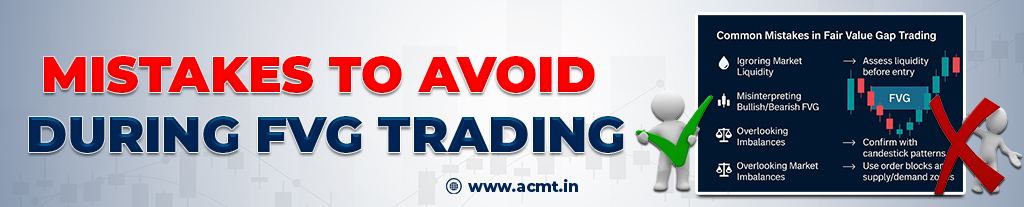
- Here are some common mistakes to avoid during FVGs.
- Don’t rely solely on the FVG indicator – you must understand the price action behind it
- Observe trend direction or structure for each FVG
- Don’t use mitigated FVGs – they don’t carry fresh liquidity
- Internal FVGs form inside consolidations – these are not signals with smart money intent
- Finally, don’t force trades in a highly volatile market.
FVGs cannot be traded with blind entries. They require structured steps with context.
Conclusion
When applied appropriately, FVGs can transform trading. These are constructive tools when integrated with premium, discount, structure, frame analysis, confirmation, etc., and are not meant to be traded in isolation. Overly complex inferences, with little differentiation between gaps, that focus on gaps unrelated to supply-demand imbalances can cause confusion and impede profitability. There are four basic rules to be followed:
- To go with the trend
- Should be seen in premium or discount
- Must trigger CHoCH or BOS(Break of Structure)
- Should be unmitigated
Thus, high-profitability trading is made possible when these pointers are followed diligently.
The Mentor
All courses are designed and delivered by Mr Arun Gupta, a seasoned trader based in Jaipur. A veteran trader and stock market guru, he has consistently offered students some of the best and most practical guidance they need, absolutely free. Check out ACMT’s Instagram account to learn more about what you can learn from these easy-to-understand snippets.
Mr Arun Gupta is a leading stock market trainer and trader who practices in Jaipur. For him, it’s not just about conventional trading. It is about applying proven methods alongside modern technology and prudence that makes a successful trader. He delves into the why, what, how and when of stock trading using the best combination of historical analysis and practical investing. With decades of experience, expertise, and learning, Mr Gupta today guides millions through the complexities of the stock market.
