
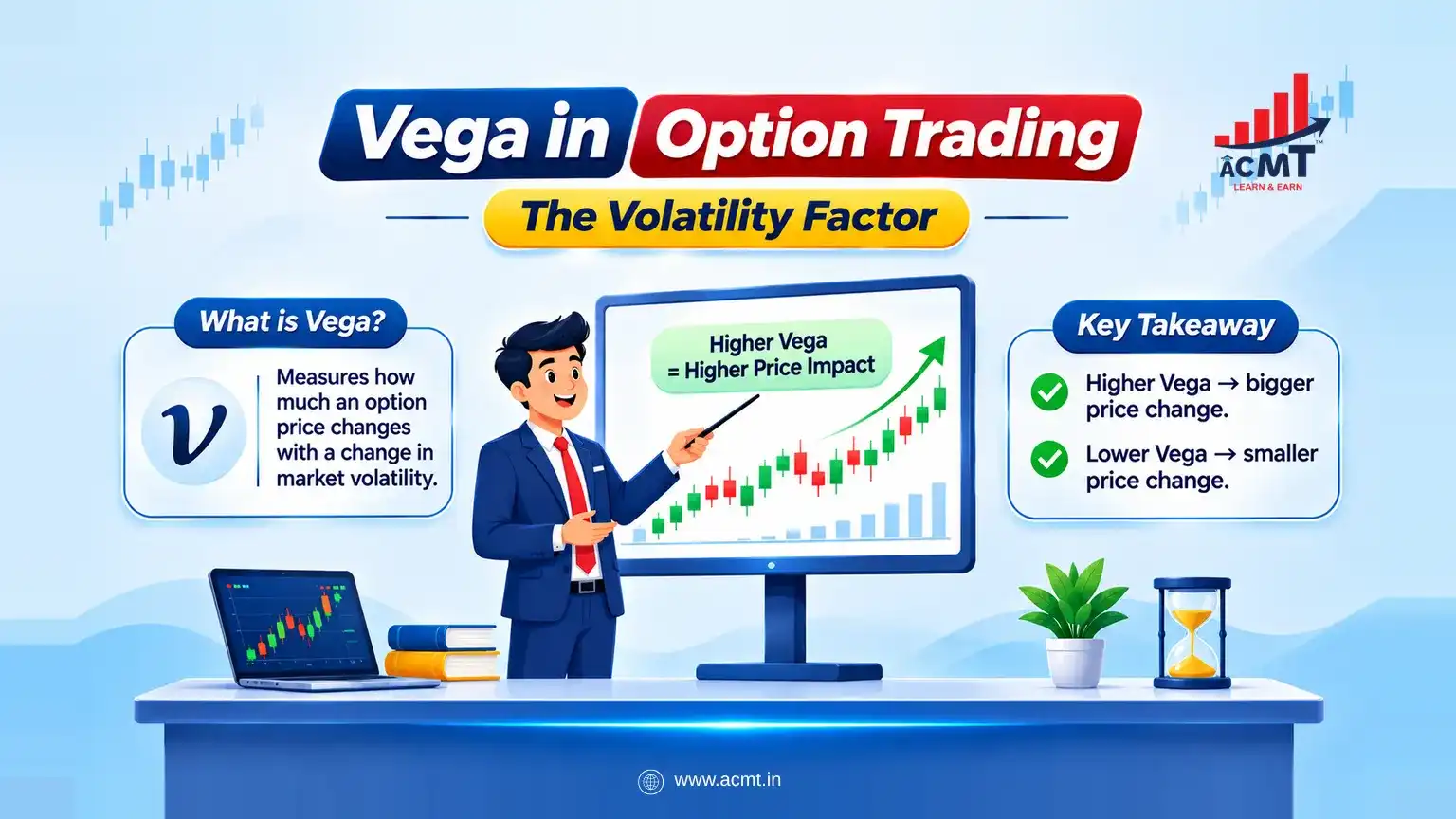
Vega in Options Trading: Meaning, Formula, Examples & Strategies
An option premium may increase in spite of minimal changes to the underlying asset or index price while trading in options. Have you ever thought about the reasons for such behavior of options trading? The first and foremost is the shift in implied volatility. That is where comes the significance of Vega in options trading.
Vega is one of the most prominent Options Greeks which will help you understand how the changes in implied volatility may influence the option premium. Whether you trade Call options, Put options, or sell options, having some knowledge about Vega will help you evaluate the volatility risks better.
In this article, we will learn what Vega in simple words is and study the basics of Vega’s formula and its correlation with implied volatility and some examples.
What Is Vega in Options Trading?
Vega is another Options Greek used to determine the effect on the theoretical price of an option from a one percentage point change in its implied volatility.
In simple terms, Vega can be described as a measurement tool for traders on how sensitive option premiums are to changes in implied market volatility.
For instance, if the Vega of an option is ₹2, then when there is a one percentage point change in implied volatility, the option premium may rise by ₹2.
Conversely, if there is a one percentage point fall in implied volatility, the option premium may fall by ₹2.
The actual price changes could vary as many other things, like the underlying price, may also change at the same time.
Vega Meaning in Stock Market
In the stock market, Vega refers to the measurement of the rate of change of the price of the option due to the change in the implied volatility.
If the expectations of change in the prices of the underlying stock are high, then implied volatility will increase. This will result in an increased price of options, as there is uncertainty about the future prices.
When the expected volatility decreases, the cost of the option premium will decrease.
How Does Vega Work in Options Trading?
This is how Vega operates; it considers the connection between the premium of an option and its implied volatility.
Imagine there are two options on the same index. Although these two options might be similar in strike price, they will certainly have different Vega values due to differences in expiry date and other pricing parameters.
Here is a brief overview of the situation:
| Market Condition | Impact on Implied Volatility | Typical Impact on Long Option Premiums |
| Implied Volatility goes up | Going up | Prices tend to go up |
| Implied volatility decreases | Going down | Prices tend to go down |
| Implied Volatility stays the same | Stays the same | Stays the same |
But the whole thing is conditional on the fact that other factors influencing the price remain unchanged. In practice, however, option prices will also depend on the price of the underlying, expiry time, interest rate, and so on.
Vega and Implied Volatility
The relationship between VEGA AND IMPLIED VOLATILITY is very strong in determining option prices.
Vega is an indication of how much an option’s price may change if there is a change in its implied volatility.
For instance, if the price of a stock is ₹1,000 and the premium of a call option is ₹40, a Vega of ₹1.50 would mean that a 1% increase in implied volatility from 20% to 21% would cause an increase in the option premium to about ₹1.50.
The new premium will thus be ₹41.50.
A fall in implied volatility by 1% from 20% to 19% may lead to a fall in the premium to ₹38.50, under unchanged conditions.
The above figures are not real market prices and are approximate only.
Vega Formula in Options Trading
The simple formula is:
Change in Option Premium = Vega × Change in Implied Volatility (Percentage Points)
For instance:
• Option Vega: ₹3
• Growth in implied volatility: 2 percentage points
• Estimated premium change: ₹3 × 2 = ₹6
With the premium of an option at ₹50, the estimated premium could rise to ₹56, other factors remaining constant.
In the case of a decrease in implied volatility by two percentage points, the estimated premium change would be approximately −₹6.
How to Calculate Vega
Let us assume that an option possesses the following features:
• Present premium: ₹100
• Vega: ₹2.50
• Present implied volatility: 25%
• New implied volatility: 28%
The difference in implied volatility is three percent.
Change in premium estimated as:
₹2.50 × 3 = ₹7.50
New premium estimated as:
₹100 + ₹7.50 = ₹107.50
Thus, the premium of the option can be expected to rise to ₹107.50.
Note that Vega is a measure of sensitivity and not a certainty.
Vega in Call Options and Put Options
Vega is applicable to both the call and the put options.
The Vega of long call and long put positions is normally positive. This implies that a rise in the volatility level results in rising premiums while a fall in volatility leads to falling premiums.
Vega of Call Option
A call option grants the holder the right to buy an asset at the agreed strike price.
An increase in the level of volatility increases the value of this right since it makes it possible for the underlying asset to change greatly before the expiry of the option.
Consequently, the premium of the call option increases.
What Factors Affect Vega in Options?
Not every option has an equivalent Vega. Various reasons are responsible for influencing the value.
1. Time to Expiration
The more time left before expiration, the more likely is the case of having Vega higher than that of an otherwise similar but closer to expiration option.
The reason why the above holds is the longer period during which price changes occur and, therefore, it makes volatility an important determinant of value.
2. Strike Price
The higher value of Vega is associated with at-the-money options rather than deeply in-the-money or out-of-the money alternatives.
3. Implied Volatility
Vega will be affected by the changes in implied volatility.
However, Vega will also change if there are any changes in the implied volatility. Therefore, the multiplication of Vega with the large change in implied volatility will give only an approximate result.
4. Market News
Market news such as earnings release, economic releases, central bank meetings, and geopolitical events can impact the implied volatility.
Prior to an expected market event, options will become more expensive because of the uncertainty.
Vega vs Delta vs Theta vs Gamma
Vega is one of the four widely discussed Options Greeks. Each Option Greek represents a specific measure of option price sensitivity.
| Options Greek | What It Measures | Main Factor |
| Delta | Sensitivity to the price of the underlying asset | price movements of the underlying asset |
| Gamma | The speed of Delta change due to price movement of the underlying | asset change in Delta |
| Theta | Sensitivity to the passage of time | Time decay |
| Vega | Sensitivity to volatility changes | volatility movements |
For instance, Delta is used by traders to measure the reaction of option premium to a change in the underlying asset price. Theta is used by traders to gauge the reaction of time passing.
The Greeks together are useful due to the fact that there are many factors affecting an option’s premium.
How Can Traders Use Vega in Options Trading?
Knowledge of Vega can be beneficial for traders in assessing their options strategies and volatility risks.
1. Prior to Purchasing Options
The buyer of the option needs to think about the anticipated direction of movement of the underlying asset and the implied volatility at the moment.
Although the underlying asset moves in the anticipated direction, the fall of the implied volatility will make the option less valuable.
2. Prior to Selling Options
It is important for the option seller to realize that the short options position usually has negative Vega.
In this case, the increase of implied volatility will have a negative effect on the short option position, and vice versa, when everything else remains constant.
But the selling of options can be quite risky.
3. Around Major Market Events
Implied volatility is usually watched prior to earning reports, economic data releases, and other such events.
It is impossible for Vega to predict whether implied volatility will go up or down following the event.
4. Portfolio Risk Management
Portfolio Vega measures the collective effect of an options portfolio on volatility changes.
The trader can apply it in determining how the positions are going to behave should there be an increase or decrease in the market volatility.
Common Mistakes Traders Make When Understanding Vega
Experienced traders could be wrong about the effect of Vega on options pricing too. The following list shows the mistakes that should be avoided.
Misunderstanding high Vega: The belief that the higher the Vega, the better is wrong.
Combination of Vega and volatility: Although Vega is sensitive to volatility, it is not sensitive to volatility of the underlying itself.
Not paying attention to Theta: The existence of time decay in the process even without any changes in the level of implied volatility.
Not paying attention to the fact that option premiums could be either up or down: Various factors affecting the price of an option could move the premium in various directions.
Conclusion
Learning about the Vega formula, the relation between Vega and implied volatility, as well as differences between Vega, Delta, Theta, and Gamma will provide the trader with a more holistic understanding of options pricing.
Nevertheless, Vega should not be used as a stand-alone factor. Sufficient knowledge regarding the Options Greeks can make the trading decisions of the trader much more informed; however, the same cannot reduce market risks or guarantee profit.
About The Author
Arun Gupta is an educationalist in the stock market and trader with a focus on technical analysis, trading techniques, market behavior, and real market education. He tries to simplify the difficult trading concepts to make them easy to learn by both novices and experienced traders.The fields of interests of Arun Gupta are technical analysis, intraday trading, options trading, demand & supply analysis, and trading view based tools. In case you want to know more about his stock market education, market insights, and other useful information, then you can visit the official website of ACMT or you can follow him on Instagram.
