
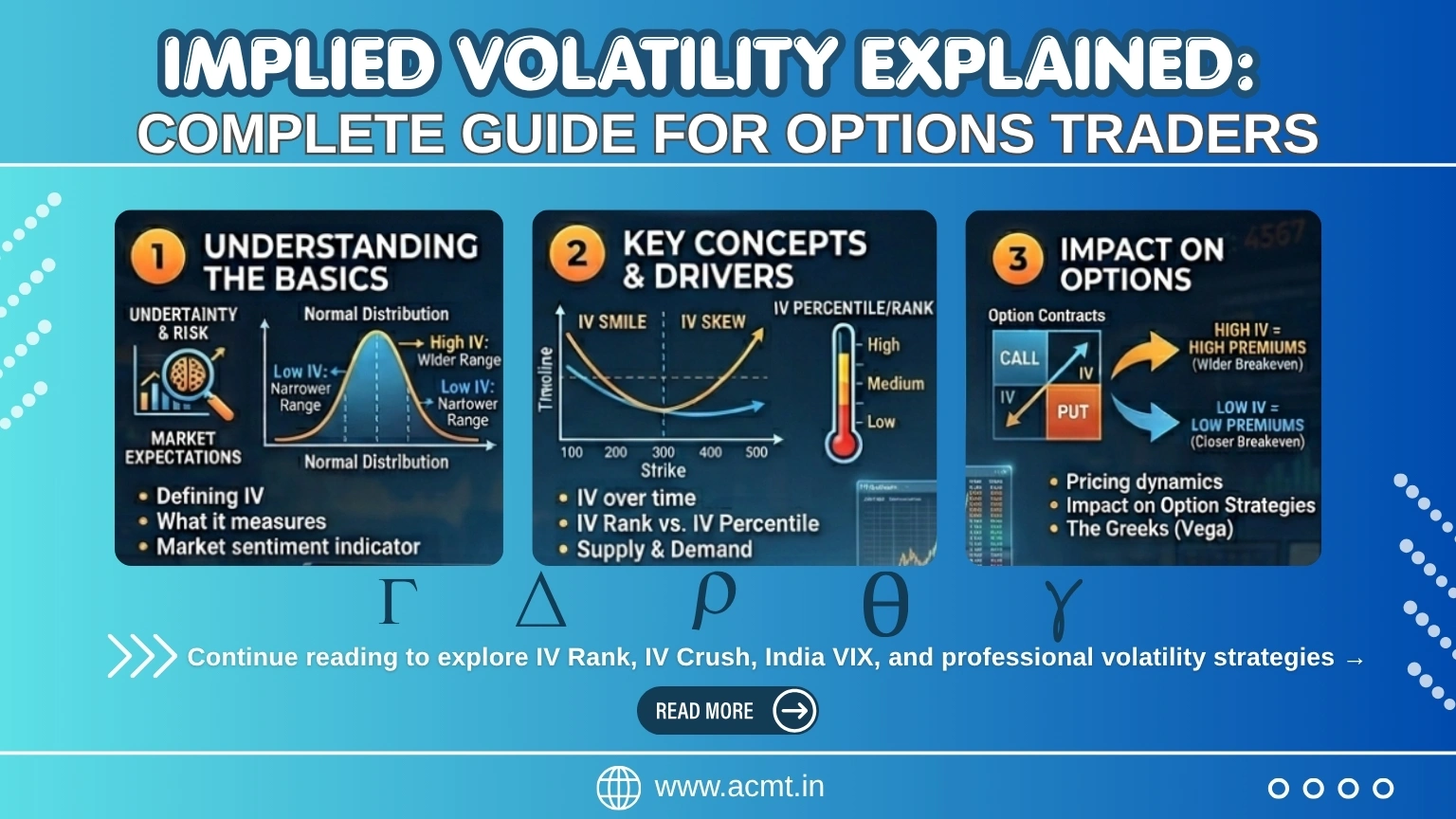
Implied Volatility Explained: Complete Guide for Options Traders
It is a deal in options trading, but a lot of people who are just starting out do not really understand what it means. While a lot of traders only think about if the market will go up or down, experienced traders think about how much the market will move. This is where Implied Volatility comes in.
Understanding Implied Volatility helps traders make choices, avoid paying too much for options, and make more consistent decisions when trading. This guide will explain Volatility in simple terms so you can use it right away.
________________________________________
What Is Implied Volatility?
Implied Volatility is like a forecast of how much a stock or index will move in the future based on the prices of options.
In terms:
– It measures how much the market is expected to move.
– It does not predict if the market will go up or down.
– It shows how uncertain the market is.
– It directly affects the prices of options.
If Implied Volatility is high, the market expects movements. If it is low, the market expects movements. This is based on how many people are buying and selling options.
________________________________________
Why Implied Volatility Is Important in Options Trading
It is crucial in determining the prices of options and helps traders decide if options are expensive or cheap. When it goes up, the prices of options go up too. When it goes down, the prices of options go down. This is true for both call and put options.
That means:
– Buyers benefit when Implied Volatility goes up.
– Sellers benefit when Implied Volatility goes down.
– Choosing the strategy depends a lot on Implied Volatility levels.
If you ignore volatility, you might lose money even if you correctly predict the market direction.
________________________________________
Difference Between Implied Volatility and Historical Volatility
Understanding the difference between Volatility and Historical Volatility helps traders compare what the market is expected to do in the future with what it has done in the past.
Historical Volatility measures:
– How much the market has moved in the past.
– What actually happened in the market?
– How much the market fluctuated before.
Implied Volatility measures:
– What the market is expected to do in the future.
– How people feel about the market.
– What people think will happen to option prices.
Traders mostly care about Implied Volatility because options trading is about what will happen, not what happened before.
________________________________________
How Implied Volatility Affects Option Premium
It affects the premium of an option, making it rise in times of uncertainty and fall during stability and lower expected movements.
The price of an option is made up of two parts:
– The intrinsic value.
– The time value.
Implied Volatility mainly affects the time value.
When Implied Volatility increases:
– The prices of call options go up.
– The prices of options go up.
– Options become more expensive.
When Implied Volatility decreases:
– The prices of options go down.
– Options become cheaper.
This happens even if the stock price stays the same. That is why it is important to check Implied Volatility before buying options.
________________________________________
Understanding IV Crush in Options Trading
IV Crush is when the prices of options suddenly drop because it goes down sharply after events.
Before announcements, people are not sure what will happen, so it goes up. After the announcement, people are more certain, so it goes down quickly.
Events that can cause IV Crush include:
– Earnings announcements.
– Budget releases.
– Policy decisions.
– Election results.
– global news events.
Many traders lose money because they buy options when it is high and then see the prices of options drop.
________________________________________
What Is IV Rank and Why Traders Use It
IV Rank compares the Implied Volatility to its range over the past year, helping traders figure out if options are expensive or cheap.
IV Rank goes from 0 to 100.
If IV Rank is:
– Above 50 means the market is very volatile.
– Below 20 means the market is not very volatile.
In trading, a high IV Rank is good for selling options, while a low IV Rank is good for buying options. This helps traders understand the market conditions quickly.
________________________________________
What is the IV Percentile?
IV Percentile shows how often it has been lower than it is now over the year.
For example, if IV Percentile is 75%, it means Implied Volatility was lower than it is now 75% of the time. This means options are relatively expensive compared to the past. Traders use IV Percentile to make decisions about when to enter trades.
________________________________________
High Implied Volatility vs Low Implied Volatility
Understanding the market conditions based on Implied Volatility helps traders choose the strategies.
High Implied Volatility Environment
This means:
– Option prices are high.
– The market expects movements.
– There is a lot of uncertainty.
– Many institutions are actively trading.
Good strategies for Implied Volatility include:
– Short straddle.
– Short strangle.
– Iron condor.
– Credit spreads.
These strategies make money when volatility goes down later.
________________________________________
Implied Volatility Environment
This means:
– Option prices are low.
– The market expects movements.
– There is no uncertainty.
– There are opportunities for breakouts.
Good strategies for Implied Volatility include:
– Long call.
– Long put.
– Debit spreads.
– Calendar spreads.
These strategies make money when volatility goes up later.
________________________________________
Relationship Between Implied Volatility and Option Buyers
Option buyers benefit when it goes up because option prices increase even if the market movement is not big. Volatility provides higher premium value, greater opportunities for profit, and lower reliance on large price movements to make profits.
Good situations for buyers include:
– When it is low.
– When a breakout is expected.
– When the market trend is reversing.
– When support or resistance is broken.
Low volatility means options. If it goes up after buying, profits increase faster.
________________________________________
Relationship Between Implied Volatility and Option Sellers
Option sellers benefit when it goes down because lower option prices mean they can keep more of the premium as profit. Decrease in volatility leads to lower risk levels, increased chance of successful outcomes, and better exploitation of time decay for the seller.
Good situations for sellers include:
– Implied Volatility environments.
– Before events.
– When the market is moving sideways.
– Weeks before options expire.
When option prices go down, it favors sellers. Time decay also helps sellers make money.
________________________________________
Role of Volatility in Index Trading
It is important in index trading because institutional investors actively trade index derivatives when the market is uncertain.
Implied Volatility usually goes up:
– Before options expire.
– Before policy announcements.
– When the global market is uncertain.
– During corrections.
Implied Volatility usually goes down:
– After big events.
– During market trends.
– During consolidation phases.
Checking it helps traders time their entries better.
________________________________________
India VIX and Its Connection With Implied Volatility
India VIX measures how the market is expected to be over the next thirty days and is often called the fear index.
When India VIX goes up:
– Market uncertainty increases.
– Option prices go up.
– People are more risk-averse.
When India VIX goes down:
– Market stability improves.
– Option prices go down.
– People are more confident.
Option traders always check the VIX before making trades.
________________________________________
Vega: Sensitivity of Options to Volatility Changes
Vega measures how much the price of an option changes when it changes.
For example, if Vega is 4 and it goes up by 1%, the option price goes up by 4 points.
Important things to know about options:
– Options that expire away have higher Vega.
– Options that expire soon have lower Vega.
– When Vega is high, it means that volatility has an impact.
Understanding Vega helps traders figure out how much the price of an option might change.
________________________________________
What is the Volatility Smile?
The volatility smile shows how volatility is different for options with strike prices.
It does not stay the same for all options.
Usually, we see that:
– Options that are not worth much have volatility.
– Options that are worth something have lower volatility.
This happens because:
– Big companies want to protect themselves from losses.
– People want to protect themselves from market crashes.
– Different people think about risk in different ways.
If traders understand the volatility smile, they can pick options.
________________________________________
Mistakes that traders make with Volatility
Many traders do not think about volatility and only think about which way the price is moving.
This leads to trading decisions.
Some common mistakes are:
– Buying options when volatility is high.
– Selling options when volatility is low.
– Not thinking about where volatility is now.
– Not thinking about the risk of volatility going down.
– Trading, without thinking during events.
If traders can avoid these mistakes, they will trade better.
________________________________________
How professional traders use Implied Volatility
Big traders use it to protect their money and make trading decisions.
They use it to:
– Pick trading strategies.
– Protect their positions.
– Control how much risk they take.
– Find good trading opportunities.
– Decide when to enter the market.
If regular traders do the same, they will trade better.
________________________________________
Conclusion
The Importance of Implied Volatility for Option Traders
It has a very significant importance in the options trading space because this measure indicates how much the markets expect the underlying instrument to move in the future. It is far from being a random number; this measure allows traders to estimate risk, spot good trading opportunities, and adopt the appropriate trading strategy.
When preparing to initiate any position involving options, option traders should be aware of the current levels of implied volatility, make comparisons with historical levels, pay attention to India VIX, look out for any approaching events, and judge whether the cost of the underlying option is high or reasonable.
Those who know how to take into account implied volatility trade in accordance with the market expectations and not with their own beliefs.
About the Author :
All courses are designed and delivered by Mr Arun Gupta, a seasoned trader based in Jaipur. In this guide about implied volatility, Arun Gupta will teach you how to gauge the expectations of the market, judge the premium value of options, and strategize based on different volatility levels. A veteran trader and stock market guru, he has consistently offered students some of the best and most practical guidance they need, absolutely free. Check out ACMT’s Instagram account to learn more about what you can learn from these easy-to-understand snippets.
Having years of experience in actual trading markets, Mr. Gupta aims at making trading derivatives and volatility strategies easy for students by explaining complex topics like IV Rank, IV Crush, India VIX, and other important aspects related to options trading.
